
Last updated September 25, 2026
Non-destructive entry first, always - and we re-key Schlage, Kwikset, and Baldwin locks on the spot while you watch
You get a price before we start. It does not change when we arrive. No surprises.
Locksmith Warning Signs: A Long Beach Homeowner’s Reference Guide
Here’s the pattern we’ve watched repeat across Long Beach for twenty-three years: a homeowner searches “locksmith near me,” clicks the top result with a 4.9-star rating and a local 562 number, and forty minutes later watches a technician drill a basic Kwikset deadbolt that could have been picked in ninety seconds. The bill runs $400-$800. The review they trusted was purchased. The address was a UPS Store. The license, when checked, belonged to a person in Fresno. This guide, alongside our The Complete Guide to Locksmith in Long Beach, maps the specific warning signs that appear at each stage of a locksmith transaction, so you can recognize the trap before the van arrives.
Quick Answer
The most reliable predictor of a locksmith scam is the refusal to provide a confirmed written price before dispatch. Legitimate Long Beach locksmiths quote firm prices for standard services, send written confirmation, and arrive in marked vehicles with verifiable licenses, as detailed in our Commercial Locksmith Maintenance Checklist for Long Beach Homeowners. Scams rely on verbal-only estimates that triple on arrival, unmarked cars, and immediate demands to drill locks that are fully serviceable.
Table of Contents
- Pre-Booking Red Flags: What to Check Before You Schedule
- On-Arrival Warning Signs: When the Technician Shows Up
- Invoice Red Flags: Charges That Weren’t Quoted
- How to Verify a Long Beach Locksmith’s Credentials
- What to Do If the Price Changes Mid-Job
- Common Mistakes to Avoid
- When to Call a Professional
- Frequently Asked Questions
Pre-Booking Red Flags: What to Check Before You Schedule
The scam is usually over before the technician knocks. The booking stage is where bait-and-switch operations separate themselves from legitimate shops, and the separation is visible if you know what to look for.
1. The Price Is Given as a “Starting From” Figure
A dispatcher who quotes “$19 service call” or “starting at $35” has not quoted a price. They’ve quoted a floor that bears no relationship to the final invoice. In our experience, that $19 call typically resolves to $300-$600 after “labor,” “high-security upgrade,” and “emergency after-hours” fees are applied at the door.
At Novak Lock & Security Long Beach, Haven Standard Clause 1 applies: the price on the phone is the price on the invoice. For a standard residential lockout in Long Beach, we quote $85-$145 depending on time of day and lock type. For a rekey of a single-cylinder deadbolt, $29-$45 per cylinder. These are confirmed in writing before dispatch. A technician who is contractually prohibited from changing the price cannot bait-and-switch.
2. No License Number Offered When Asked
California requires every locksmith to hold a Bureau of Security and Investigative Services (BSIS) locksmith license. The legitimate operator will provide this number without hesitation. The scam operation will deflect, offer a “business license” number (meaningless for this purpose), or claim the technician carries the license (technicians work under a company license; individual registration is separate and supplementary).
Ask specifically: “What is your BSIS locksmith company license number?” Write it down. Verify it before you book.
3. The Call Is Answered With a Generic Greeting
“Locksmith services, how can I help you?” is not a business name. It’s a call-center filter serving dozens of shell listings. The legitimate shop answers with its actual name. If you have to ask “What company is this?” the structure is already wrong.
4. No Written Confirmation Sent
A verbal quote dissolves the moment the technician arrives. The legitimate shop emails or texts a written confirmation with:
- The service requested
- The quoted price range
- The technician’s name
- The license number
- The vehicle description
We send this automatically. Scam operations resist creating a paper trail.
5. The Listed Address Cannot Be Verified
Search the business address on Google Street View. A UPS Store mailbox, a virtual office suite, or a residential apartment used as a “dispatch center” are common setups for lead-generation operations that sell your call to the lowest-bidding subcontractor. In Long Beach, we’ve seen scam listings use addresses on Pacific Coast Highway that resolve to strip-mall mailboxes with no locksmith presence.
A real shop has a real location. You should be able to drive to it.
On-Arrival Warning Signs: When the Technician Shows Up
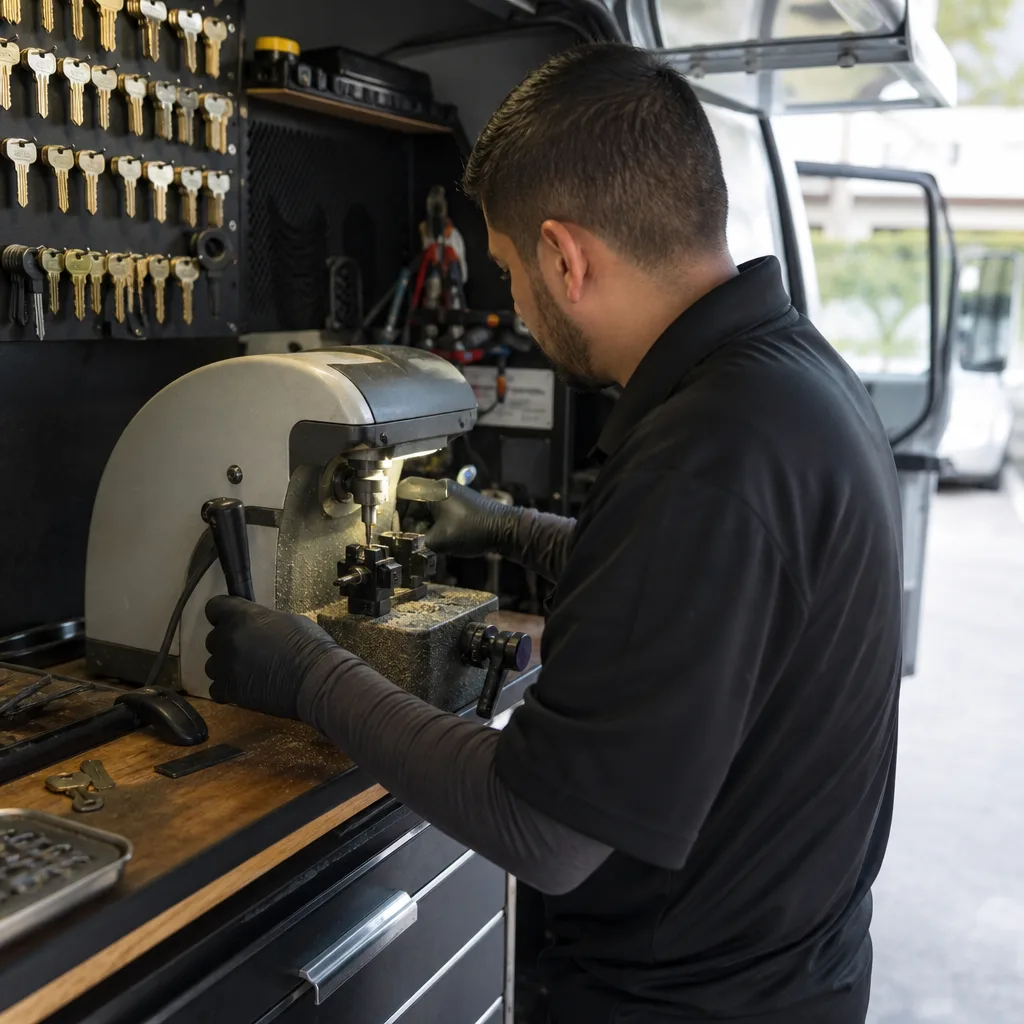
The technician’s arrival is the second filter. Here’s what we tell customers to observe before any work begins.
1. Unmarked Vehicle
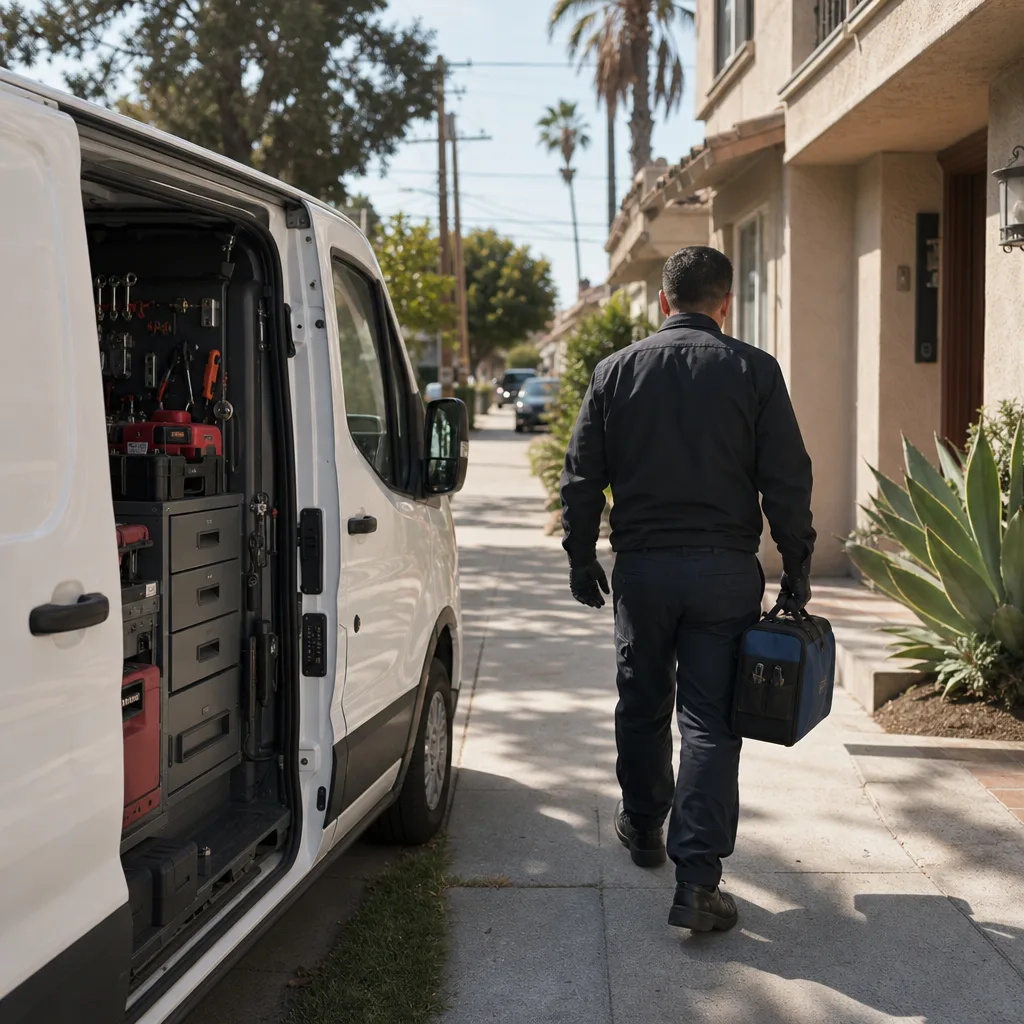
No company name, no license number on the door, a plain white van or personal vehicle. This is standard for subcontractor networks: the call center takes your booking, farms it to an independent operator with no company affiliation, and takes a percentage. The operator has no brand reputation to protect and no incentive to honor the phone quote.
Our vans carry the Novak name, the Haven Standard mark, and the BSIS license number. The technician’s photo ID is offered before entry.
2. No Uniform or Photo ID
California law requires locksmiths to carry BSIS-issued identification. The legitimate technician presents it without being asked. The scam operator may produce a generic “contractor” badge or nothing at all.
3. The Quote Differs From the Phone Price
This is the moment of the switch. The technician claims the lock is “high-security” (it isn’t), the job is “more complicated than described” (it isn’t), or an “emergency rate” applies (it wasn’t mentioned). The price doubles or triples.
Under Haven Standard Clause 1, our technicians are not permitted to change the quoted price. If the scope changes, the customer is called before any additional work begins, and the new scope is documented in writing.
4. Immediate Recommendation to Drill
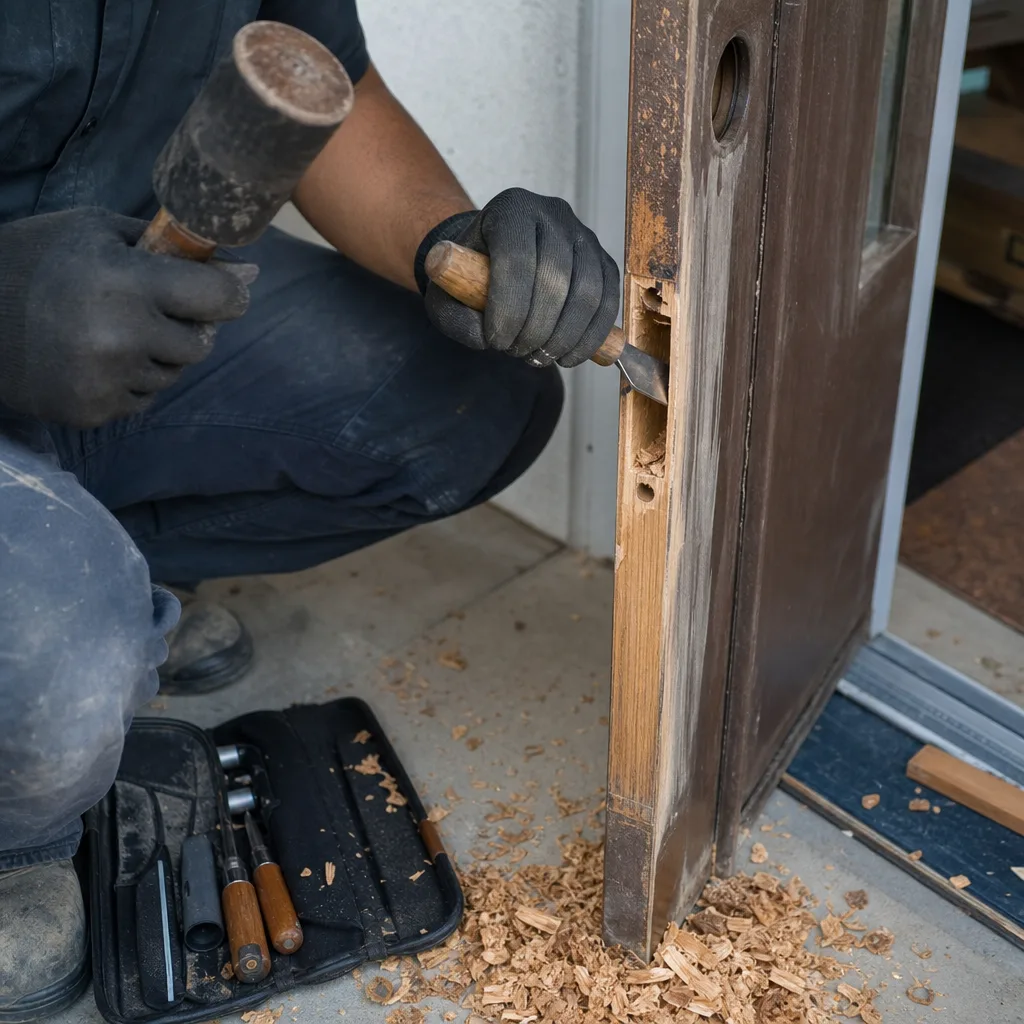
A basic residential deadbolt, properly installed, can be picked or bypassed by a trained technician in the vast majority of lockout situations. Drilling is the method of last resort, used when a lock is damaged, high-security, or genuinely unpickable. The scam technician drills immediately because drilling destroys the lock, forcing a replacement sale, and because drilling requires less skill than picking.
In Belmont Shore and Naples, we’ve responded to calls where a “locksmith” had drilled a standard Schlage deadbolt in under two minutes and was presenting a $600 invoice for lock replacement. The lock was a $45 hardware-store grade cylinder. It should have been picked.
5. Pressure to Begin Before Paperwork
The technician wants to start immediately, before you’ve seen a written scope or confirmed the price. This urgency is manufactured. Every legitimate shop will pause for you to read and acknowledge the work order.
Invoice Red Flags: Charges That Weren’t Quoted
The invoice is where the arithmetic of the scam becomes visible. Here’s what we find on disputed bills from Long Beach homeowners.
1. “High-Security Cylinder” Upgrade Never Discussed
The technician installs a standard grade-2 deadbolt and bills it as “high-security.” True high-security cylinders, brands like Mul-T-Lock or Medeco, are visibly distinct: they use restricted keyways, hardened drill-resistant inserts, and pick-resistant pin configurations. They cost $150-$400 per cylinder, not $19. If you didn’t discuss restricted key control and didn’t receive a registration card for your key blanks, you didn’t get high-security hardware.
2. Labor Split Into Multiple Unquoted Line Items
“Service call,” “diagnostic fee,” “labor,” “trip charge,” “after-hours surcharge,” “equipment fee.” These should be consolidated into the single price you were quoted. Itemization is fine, but the total must match the confirmed quote. If the phone quote was “$85-$145 for lockout service” and the invoice shows six lines totaling $340, the quote was not honored.
3. Demand for Cash Only
Cash-only demands serve two purposes: they avoid credit card chargebacks, and they leave no transaction record. A legitimate shop accepts standard payment methods and provides a detailed receipt.
4. No Written Warranty or Guarantee
Our work carries the 365-Day Done Right Promise, documented on every invoice. Scam operators provide no warranty documentation because they have no intention of responding to a callback.
5. Vague Company Name on Invoice
The invoice shows a different business name than the one you called, or a generic “Locksmith Services LLC” with no verifiable address. This is the subcontractor model: your call was sold to a third party, and the paper trail is deliberately fragmented.
How to Verify a Long Beach Locksmith’s Credentials
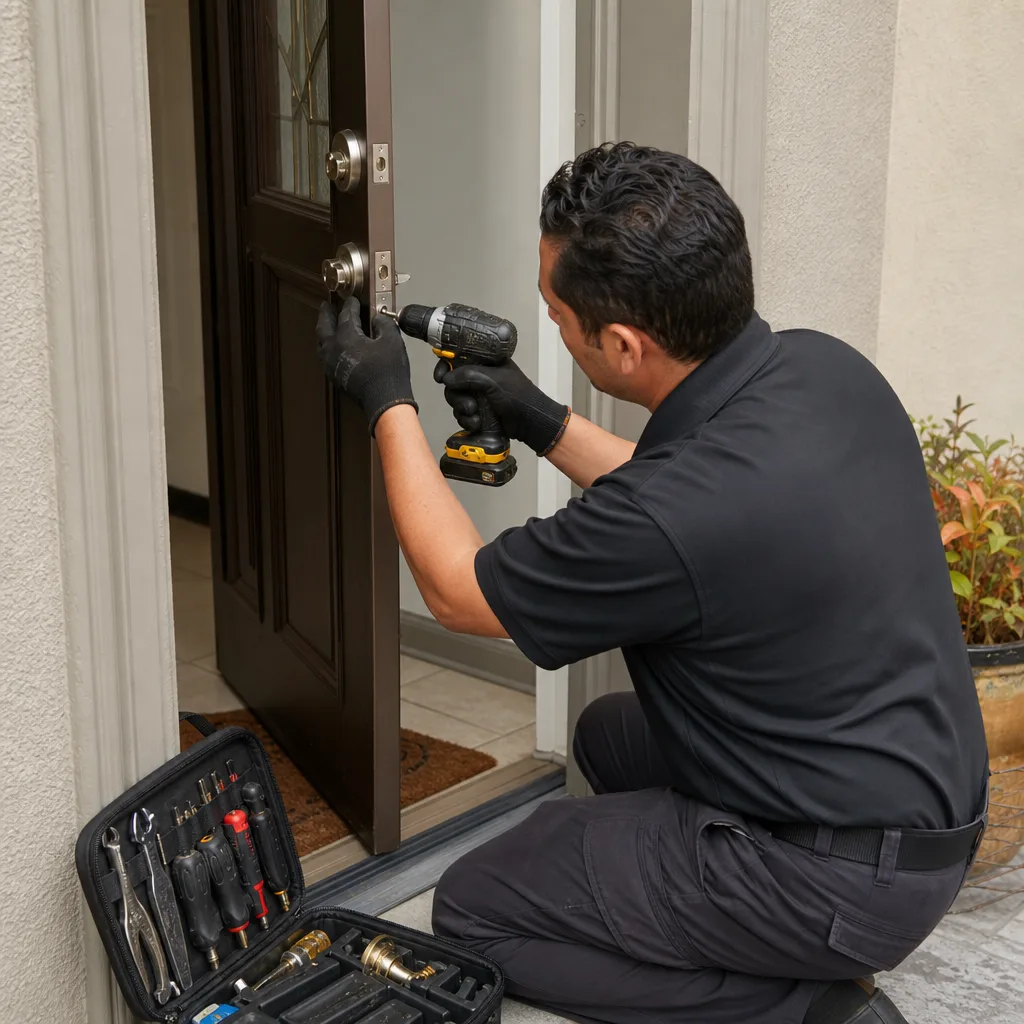
Verification takes five minutes and prevents most scams. Here’s the sequence we recommend.
- Request the BSIS company license number. California locksmiths must hold a Bureau of Security and Investigative Services locksmith company license. The number format is LCO followed by digits. Write it down.
- Verify online at bsis.ca.gov. The license status, business name, and license holder should match what you were told. If the license is expired, suspended, or held by a person in a different city, stop.
- Check the physical address on Google Street View. Look for a real storefront, industrial suite, or service bay. A mailbox in a strip mall or a residential address used as a “dispatch office” is a warning sign. In Long Beach, legitimate shops operate from verifiable commercial locations, not virtual offices.
- Search the business name plus “complaint” or “scam.” Look for patterns in three-star reviews and complaint board posts. One angry customer is noise; ten reports of price tripling is signal.
- Call back the number and ask for the dispatcher by name. Scam operations use rotating call centers. The person who answers may not know your call or the quote you received.
- Ask about warranty documentation before booking. A shop that cannot describe its warranty in writing has no warranty infrastructure.
In Long Beach’s climate, hardware corrosion from marine air is a genuine factor in lock longevity, which is why we published Seasonal Locksmith Care for Long Beach: Year-Round Homeowner’s Guide. A local shop understands this, stocks appropriate finishes and lubricants, and warranties its work accordingly. A call-center operation dispatches whoever is available, regardless of regional knowledge.
What to Do If the Price Changes Mid-Job
If you’re already in the transaction and the technician presents a price above the confirmed quote, you have rights and options.
Your Rights Under California Law
California’s Unfair Business Practices Act (Business and Professions Code Section 17200) prohibits deceptive pricing in home services. The “bait and switch” specifically, advertising a low price to attract customers and then charging a higher price, is actionable. You are not obligated to pay a price that was not confirmed in writing before work began.
Immediate Steps to Take
- Stop the work. State clearly: “This price was not quoted. Please stop.” You are not required to allow continued work under duress.
- Document everything. Photograph the technician’s ID, the vehicle, and any paperwork. Note the time and location.
- Do not sign anything under pressure. A signature obtained through intimidation or misrepresentation is not valid consent.
- Call the police if threatened. Some scam operators become aggressive when challenged. This is rare but documented. Your safety takes priority over the lock.
- File complaints with BSIS, the California Attorney General, and the FTC. These agencies track patterns. Individual complaints build cases.
- Dispute credit card charges if paid under duress. Credit card companies recognize bait-and-switch patterns and will reverse charges with documentation.
We offer a Free Second Opinion on Any Written Estimate. Bring us a competitor’s quote, even mid-dispute, and we will review it at no charge. We’ve documented cases in Bixby Knolls and Signal Hill where our review revealed $400+ in unsupported charges on invoices from scam operators.
Common Mistakes to Avoid
- Trusting the top Google result without verification. Paid ads and local service ads appear first by default. They are not ranked by legitimacy. Verify independently.
- Booking based on star rating alone. Review manipulation is widespread in this trade. Five-star ratings with generic text, no owner response, and clustered posting dates are purchased.
- Accepting a verbal quote as binding. A quote given only by phone, with no written confirmation, is not enforceable. The scam operator knows this.
- Allowing work to begin before seeing ID. California law requires locksmith identification. The technician who resists showing it is operating outside the law.
- Assuming a 562 area code means local operation. VoIP numbers can be assigned to any area code from anywhere. The 562 number may route to a call center in another state.
- Paying cash under pressure. Cash removes your recourse. Credit cards provide dispute rights and create a transaction record.
- Not checking the BSIS license before the emergency. The worst time to verify credentials is when you’re locked out at 11 PM. Save a verified locksmith’s contact in your phone before you need it.
When to Call a Professional
Call a licensed locksmith when you’re locked out, when keys are lost or stolen, when moving into a new home, when a lock malfunctions, or when you need security assessment after a break-in. In Long Beach’s older neighborhoods like California Heights and Bluff Park, original hardware from the 1920s-1950s requires knowledgeable service, not force.
Novak Lock & Security Long Beach offers free estimates in Long Beach. Call (424) 340-6795. We’ll confirm a written price before dispatch, send technician documentation, and honor Haven Standard Clause 1: the price on the phone is the price on the invoice.
Frequently Asked Questions
A standard residential lockout in Long Beach typically runs $85-$145, a rekey $29-$45 per cylinder, and a deadbolt installation $125-$225 including hardware. These are firm ranges quoted in writing before dispatch. Call (424) 340-6795 for an exact quote on your specific situation, estimates are free.
At Novak Lock & Security Long Beach, yes. Haven Standard Clause 1 prohibits our technicians from changing the quoted price at the door. If the scope changes, we call for written authorization before additional work begins. This rule has been in place since 2002.
Ask for the BSIS company license number and verify it at bsis.ca.gov. The license status, business name, and holder must match. A legitimate locksmith provides this without hesitation. If they refuse or offer a “business license” instead, do not book.
Drilling destroys the lock, forcing a replacement sale, and requires less skill than picking or bypassing. A trained technician can open most standard residential locks without drilling. Immediate drilling is a warning sign of an unskilled operator or a deliberate upsell strategy.
Decline and end the transaction. Cash-only demands avoid chargeback rights and transaction records. A legitimate shop accepts standard payment methods and provides detailed receipts. If you’re mid-job, stop the work, document everything, and dispute any charges paid under duress.
Yes. Search the listed address on Google Street View. Look for a real commercial location, not a UPS Store, virtual office, or residential address. In Long Beach, we’ve documented scam listings using addresses that resolve to mailboxes or nonexistent suites. A real shop has a real location you can visit.
The Bottom Line
The locksmith scam is not sophisticated. It relies on urgency, trust in online ratings, and the customer’s inability to verify credentials under pressure. The defense is equally simple: demand a written price before dispatch, verify the BSIS license, check the physical address, and observe the technician’s vehicle and ID on arrival. For more guides & resources, visit our blog. These four steps eliminate most scam operations before any work begins. In Long Beach, where marine climate accelerates hardware wear and older neighborhoods preserve unique lock configurations, a verified local shop provides service that a call-center network cannot replicate. The price you confirm in writing is the price you should pay. Nothing less is acceptable.
Written by Daniel Novak, Owner at Novak Lock & Security Long Beach, serving Long Beach since 2002.